Engineers with NASA’s Exploration Ground Systems completed integrating the aerodynamic nose cones onto the left and right forward assemblies on the twin SLS (Space Launch System) solid rocket boosters, finishing their stacking operations for Artemis III inside the Vehicle Assembly Building’s High Bay 3 at NASA’s Kennedy Space Center in Florida on Wednesday, Sept. 30, 2026. Each forward assembly contains an aerodynamic top, a forward skirt housing avionics, and frustum housing motors that allow the boosters to separate from the SLS core stage after launch. Credit: Jean Wright/SpaceUpClose.com
Story by Jean Wright; KENNEDY SPACE CENTER, FL – NASA has completed stacking of the twin Solid Rocket Boosters (SRBs) motor segments destined for use on NASA’s Artemis III mission launching to low Earth orbit targeting NET later summer 2027 from NASA’s Kennedy Space Center in Florida.
Media including myself were taken on a tour inside the NASA’s Vehicle Assembly Building (VAB) in early October to capture the progress of the Artemis III five segment SRB assembly and stacking operations atop the mobile launcher inside the VAB High Bay 3 at NASA KSC
Engineers with NASA’s Exploration Ground Systems completed integrating the aerodynamic nose cones onto the left and right forward assemblies on the twin SLS (Space Launch System) solid rocket boosters, finishing their stacking operations for Artemis III inside the Vehicle Assembly Building’s High Bay 3 at NASA’s Kennedy Space Center in Florida on Wednesday, Sept. 30, 2026. Each forward assembly contains an aerodynamic top, a forward skirt housing avionics, and frustum housing motors that allow the boosters to separate from the SLS core stage after launch. Credit: Jean Wright/SpaceUpClose.com
“Teams have completed the integration of the final solid rocket booster motor segments onto the mobile launcher for the “short stack” configuration that will be used during a tanking test,” NASA confirmed in a blog post on Oct. 13.
Engineers with NASA’s Exploration Ground Systems completed integrating the aerodynamic nose cones onto the left and right forward assemblies on the twin SLS (Space Launch System) solid rocket boosters, finishing their stacking operations for Artemis III inside the Vehicle Assembly Building’s High Bay 3 at NASA’s Kennedy Space Center in Florida on Wednesday, Sept. 30, 2026. Each forward assembly contains an aerodynamic top, a forward skirt housing avionics, and frustum housing motors that allow the boosters to separate from the SLS core stage after launch. Credit: Jean Wright/SpaceUpClose.com
Enjoy our SRB stacking photos and core stage photos taken by Jean Wright for Space UpClose
Engineers with NASA’s Exploration Ground Systems completed integrating the aerodynamic nose cones onto the left and right forward assemblies on the twin SLS (Space Launch System) solid rocket boosters, finishing their stacking operations for Artemis III inside the Vehicle Assembly Building’s High Bay 3 at NASA’s Kennedy Space Center in Florida on Wednesday, Sept. 30, 2026. Each forward assembly contains an aerodynamic top, a forward skirt housing avionics, and frustum housing motors that allow the boosters to separate from the SLS core stage after launch. Credit: Jean Wright/SpaceUpClose.com
“Each forward assembly contains an aerodynamic top, a forward skirt housing avionics, and frustum housing motors that allow the boosters to separate from the SLS core stage after launch.”
The twin solid boosters will help support the remaining rocket components and the Orion spacecraft during final assembly of the Artemis III rocket and provide more than 75 percent of the total SLS thrust during liftoff from NASA Kennedy’s Launch Pad 39B
Artemis III core stage during media tour in Oct 2026 inside the Vehicle Assembly Building’s High Bay 2 at NASA’s Kennedy Space Center in Florida. Will be transferred to High Bay 3 for attachment to twin SRBs. Credit: Jean Wright/SpaceUpClose.com
“Teams now will install the systems tunnel that runs the length of the core stage and is used to route pyrotechnic cabling, a system of wiring that allows the single-use, quick disconnect for controlled movements during liftoff, on the massive stage. In the coming weeks, the stage will be integrated with the solid rocket boosters, completing the rocket’s “short stack” configuration,” NASA reported.
Artemis III core stage during media tour in Oct 2026 inside the Vehicle Assembly Building’s High Bay 2 at NASA’s Kennedy Space Center in Florida. Will be transferred to High Bay 3 for attachment to twin SRBs. Credit: Jean Wright/SpaceUpClose.com
Thereafter the core stage will be transferred to High Bay 3 for integration with the twin stacked SRBs
Teams will then complete the assembly of the short stack configuration of NASAs SLS Artemis III rocket minus an upper stage and Orion crew capsule
Engineers with NASA’s Exploration Ground Systems completed integrating the aerodynamic nose cones onto the left and right forward assemblies on the twin SLS (Space Launch System) solid rocket boosters, finishing their stacking operations for Artemis III inside the Vehicle Assembly Building’s High Bay 3 at NASA’s Kennedy Space Center in Florida on Wednesday, Sept. 30, 2026. Each forward assembly contains an aerodynamic top, a forward skirt housing avionics, and frustum housing motors that allow the boosters to separate from the SLS core stage after launch. Credit: Jean Wright/SpaceUpClose.com
NASA hopes to move the short stack to Launch Comple-39B by years end for tanking test with the cryogenic propellants to ensure their readiness for flight
“NASA will roll the short stack SLS rocket from the spaceport’s Vehicle Assembly Building to Launch Pad 39B for a tanking test in the coming months, where the Artemis launch team will practice procedures and timelines for loading propellant.”
Engineers with NASA’s Exploration Ground Systems completed integrating the aerodynamic nose cones onto the left and right forward assemblies on the twin SLS (Space Launch System) solid rocket boosters, finishing their stacking operations for Artemis III inside the Vehicle Assembly Building’s High Bay 3 at NASA’s Kennedy Space Center in Florida on Wednesday, Sept. 30, 2026. Each forward assembly contains an aerodynamic top, a forward skirt housing avionics, and frustum housing motors that allow the boosters to separate from the SLS core stage after launch. Credit: Jean Wright/SpaceUpClose.com
Meanwhile at the pad, “the Artemis III crew, NASA astronauts Randy Bresnick, Frank Rubio, Andre Douglas, and ESA (European Space Agency) astronaut Luca Parmitano, also will conduct a launch day rehearsal and emergency exit walkdown. This will include suiting up in astronaut crew quarters, driving to the launch pad, ascending the mobile launcher, and then walking through the exit route they would take in the unlikely event of an emergency during launch countdown.”
Artemis III is projected to fly sometime in the second half of 2027 – but no specific target date has been announced
Artemis III core stage during media tour in Oct 2026 inside the Vehicle Assembly Building’s High Bay 2 at NASA’s Kennedy Space Center in Florida. Will be transferred to High Bay 3 for attachment to twin SRBs. Credit: Jean Wright/SpaceUpClose.com
During a media event in Aug 2026, NASA Administrator Jared Isaacman told Ken Kremer of Space UpClose that he is “extremely confident” that NASA’s Artemis III mission will launch next year in 2027 where NASA’s Orion crewed spacecraft is scheduled to dock with both of the commercial human lunar landers being built by SpaceX and Blue Origin – under contract to NASA.
“I’m extremely confident that we are we are going to be able to launch Artemis III next year. That’s why we stepped into stacking operations,” Isaacman said to Ken Kremer.
The Artemis III SLS core stage was transported inside NASA’s Pegasus barge from NASA Michoud and arrived at the KSC Complex 39 Turn Basin Wharf at KSC Press Site on April 27th, to NASA’s Kennedy Space Center.
Enjoy our core stage arrival, offloading and Pegasus tour photos taken by Ken Kremer and Jean Wright for Space UpClose
NASA Nancy Grace Roman Space Telescope arrives in NASA’s Pegasus barge on Father’s Day, June 21, 2026 at NASA’s Kennedy Space Center. On the way to its Payload Hazardous Servicing Facility (PHSF) processing facility to prepare for launch NET Aug 30, 2026 on SpaceX Falcon Heavy rocket from pad 39A KSC. Roman is NASAs next great space observatory! Credit: Ken Kremer/SpaceUpClose.com
The 900-mile journey from NASA’s Michoud Assembly Facility in New Orleans – where the core stage is manufactured – took 6 days. There are 6 crew members on board Pegasus during its maritime travels
NASA’s top four-fifths of the SLS (Space Launch System) core stage for the Artemis III mission is offloaded from the agency’s Pegasus barge on Tuesday, April 28, 2026, after arriving at the Kennedy Space Center in Florida the prior day. Artemis III will launch astronauts to Earth’s orbit aboard the Orion spacecraft on top of SLS to test rendezvous and docking capabilities between Orion and commercial spacecraft from SpaceX and or Blue Origin needed to land Artemis IV astronauts on the Moon in 2028. Credit: Ken Kremer / Spaceupclose.com
Next day the stage was offloaded from Pegasus on a wheeled transporter and transported into the VAB via the KSC Press site parking lot
Originally built in 1999, Pegasus transported shuttle ET’s (External Tanks) to KSC.
NASA’s top four-fifths of the SLS (Space Launch System) core stage for the Artemis III mission is offloaded from the agency’s Pegasus barge on Tuesday, April 28, 2026, after arriving at the Kennedy Space Center in Florida the prior day. Artemis III will launch astronauts to Earth’s orbit aboard the Orion spacecraft on top of SLS to test rendezvous and docking capabilities between Orion and commercial spacecraft from SpaceX and or Blue Origin needed to land Artemis IV astronauts on the Moon in 2028. Credit: Ken Kremer / Spaceupclose.com
The ET holds the over 700,000 gallons of liquid oxygen (LOX) and liquid hydrogen (LH2) propellants that fuel the four RS-25 engines located at the base of the SLS core stage
The SLS core stage at 212 ft length remains the largest cargo the ship has ever carried.
NASA hopes to launch the crewed Artemis 3 later next year into Earth orbit to test rendezvous and docking capabilities between Orion and both of the commercial lunar landing spacecraft from SpaceX and Blue Origin needed to land astronauts on the Moon sometime in 2028.
Inside the VAB the core stage was joined to the previously delivered boat-tail and engine section in the facility’s High Bay 2 for outfitting and vertical integration to complete the full stage.
The Artemis III core stage was moved and placed horizontally in the transfer aisle of the VAB before being lifted into High Bay 2, where it was connected to the engine section and its boat-tail, which were integrated in August 2025.
At 212 feet tall when fully assembled, the core stage houses two propellant tanks that collectively hold more than 733,000 gallons of super-chilled liquid propellant to fuel four RS-25 engines, as well as the flight computers, or avionics, that act as the brains of the rocket to control flight during ascent.
This marks the first time core stage assembly operations were taking place at NASA Kennedy.
Engineers with NASA’s Exploration Ground Systems completed integrating the aerodynamic nose cones onto the left and right forward assemblies on the twin SLS (Space Launch System) solid rocket boosters, finishing their stacking operations for Artemis III inside the Vehicle Assembly Building’s High Bay 3 at NASA’s Kennedy Space Center in Florida on Wednesday, Sept. 30, 2026. Each forward assembly contains an aerodynamic top, a forward skirt housing avionics, and frustum housing motors that allow the boosters to separate from the SLS core stage after launch. Credit: Jean Wright/SpaceUpClose.com
The Artemis I & II core stages were fully assembled at Michoud before shipping to KSC
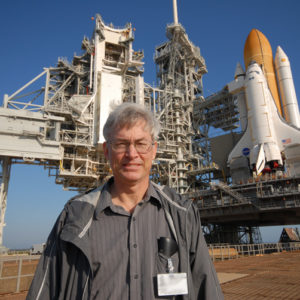
Jean Wright of Space UpClose poses with Artemis III SRB stack during media tour in Oct 2026 inside the Vehicle Assembly Building’s High Bay 3 at NASA’s Kennedy Space Center in Florida. Credit: Jean Wright/SpaceUpClose.com
Jean Wright of Space UpClose poses with Artemis III core stage during media tour in Oct 2026 inside the Vehicle Assembly Building’s High Bay at NASA’s Kennedy Space Center in Florida. Credit: Jean Wright/SpaceUpClose.comKen Kremer of Space UpClose reporting on NASA’s Artemis III core stage arrival and transport into the VAB on April 28, 2026 at the Kennedy Space Center, FL. Credit: Ken Kremer / Spaceupclose.comJean Wright and Ken Kremer of Space UpClose touring NASA Pegasus barge docked at KSC Press Site turn basin wharf on April 29, 2026, after delivering NASA’s Artemis III SLS rocket core stage to the Kennedy Space Center. Credit: Ken Kremer / Spaceupclose.com
Watch for Ken’s continuing onsite coverage of NASA, SpaceX, ULA, Boeing, Lockheed Martin, Northrop Grumman and more space and mission reports direct from Kennedy Space Center and Cape Canaveral Air Force Station in Florida and Wallops Flight Facility in Virginia. Stay tuned here for Ken's continuing Earth and Planetary science and human spaceflight news. Dr. Kremer is a research scientist and journalist based in the KSC area, active in outreach and interviewed regularly on TV and radio about space topics. Ken’s photos are for sale and he is available for lectures and outreach events.
TITUSVILLE, FL – On Nov. 13 I was interviewed live on FOX 35 Orlando for my commentary and analysis about why the ULS Vulcan Amazon Leo 1 originally scheduled for Nov. 13 was delayed a day to NET Nov. 14 due to a ‘power interrurtion’. We discussed all the issues about the scrubbed ULA Vulcan rocket launch as well as
CAPE CANAVERAL SPACE FORCE STATION, FL – After a one day Friday the 13th delay due to ‘power interruptions’ and a lengthy grounding following the Feb 2026 launch anomaly the ULA Vulcan Centaur rocket is planned to lift off for only the fifth time on Saturday morning,Nov. 14, on the Leo 1 commercial mission for delivery of a heavy batch
2 thoughts on “Artemis III Solid Rocket Booster Stacking Complete inside VAB at NASA KSC: Photos”





2 thoughts on “Artemis III Solid Rocket Booster Stacking Complete inside VAB at NASA KSC: Photos”